So you’ve decided to finally get serious about budgeting — good. That decision alone puts you ahead of most people. The hard part isn’t the math; it’s figuring out which method actually works for the way you live, spend, and think about money.
If you’ve been spending without a plan and wondering why there’s nothing left at the end of the month, that’s exactly what this is for. You just haven’t had a system. This guide walks you through the most practical budgeting strategies out there — explained simply, so you can pick one and actually start.
First: What Even Is a Budget?
Think of a budget as a plan for your money. Before the month starts, you decide where your money goes — instead of wondering where it went afterward.
Here’s a quick breakdown of terms you’ll see throughout this article:
| Term | What It Means |
|---|---|
| Income | Money coming in (salary, freelance, side hustle) |
| Fixed expenses | Bills that don’t change — rent, loan payments, insurance |
| Variable expenses | Bills that change monthly — groceries, gas, dining out |
| Discretionary spending | Optional stuff — Netflix, hobbies, shopping |
| Savings goals | Money you’re setting aside for something specific |
| Emergency fund | A safety net for unexpected expenses (car repair, medical bills) |
| Debt repayment | Extra payments toward credit cards, student loans, etc. |
Got those? Good. Now let’s get into the actual strategies.
💡 If you’re looking to understand budgeting better, take a look at our guides and tools for managing your money.
Explore Budgeting Calculators & GuidesPercentage-Based Budgeting Methods: 50/30/20, 80/20, and More
Best for: Beginners who want a simple, flexible framework without tracking every single purchase.
Percentage-based budgets are the most beginner-friendly of all budgeting methods because the math is already done for you. You just split your income into broad buckets by percentage and make sure your spending lands roughly in the right zone each month.
The 50/30/20 Rule (Most Popular)
The 50/30/20 budget rule divides your after-tax income (the money you actually take home) into three categories:
| Category | Percentage | Examples |
|---|---|---|
| Needs | 50% | Rent, groceries, utilities, insurance, minimum debt payments |
| Wants | 30% | Dining out, streaming services, hobbies, travel |
| Savings / Debt | 20% | Emergency fund, retirement, extra loan payments |
Example: If you take home $3,000 a month:
- $1,500 → Needs
- $900 → Wants
- $600 → Savings or debt repayment
No logging every coffee purchase. Just check in at the end of the month and make sure you’re in the right zone.
Other Percentage Variations
If 50/30/20 doesn’t quite match your situation, there are alternatives:
| Method | Split | Best For |
|---|---|---|
| 80/20 | 20% savings 80% spending |
A simple, flexible approach. Good if you already manage money well. No need to track every expense. |
| 70/20/10 | 70% expenses 20% save or debt 10% extra or giving |
Works well if your expenses are higher. Lets you save while covering essentials. |
The honest limitation: These methods assume some financial breathing room. If your rent alone eats up 55–60% of your income, the math won’t balance — and that’s not your fault. In that case, use the percentages as a general direction, not a strict rule.
Tip: If your income varies month to month, use your lowest earning month as your baseline. In higher-income months, put the extra toward savings or debt.
Zero-Based Budgeting
Best for: Detail-oriented people who want complete control over every dollar.
The idea here: every dollar you earn gets assigned a specific job before the month begins. At the end, your income minus all your expenses and savings equals zero. Not because you spent everything — but because every dollar has a purpose.
How it works, step by step:
- Write down your total monthly take-home income.
- List every single expense — rent, groceries, subscriptions, savings, debt payments.
- Keep subtracting until you hit $0.
- Track your spending all month to stay on plan.
Example: (Based on $4,500/month take-home)
| Category | Amount |
|---|---|
| Rent | $1,400 |
| Groceries | $600 |
| Utilities | $180 |
| Car payment + gas | $520 |
| Insurance | $200 |
| Emergency fund | $300 |
| Dining out | $250 |
| Subscriptions | $80 |
| Student loan payment | $350 |
| Clothing / personal care | $150 |
| Miscellaneous | $470 |
| Total | $4,500 |
If you’ve ever thought, “I make decent money, but I’m still not getting ahead” — zero-based budgeting will show you exactly where the leaks are.
The downside: It takes real time and consistent tracking. If the idea of logging every transaction sounds exhausting, this might not be your starting point.
Want to try zero-based budgeting but not sure where to start? Use our free calculator to assign every dollar a job — just plug in your income and expenses and it does the math for you.
Try the Free Zero-Based Budget CalculatorThe Pay Yourself First Method (a.k.a. Reverse Budgeting)
Best for: People who struggle to save because there’s “never anything left over.”
Here’s why most people fail at saving: they pay all their bills, spend throughout the month, and try to save whatever’s left. There’s usually nothing left.
The fix: Flip the order entirely.
The moment your paycheck comes in, you move a set amount straight to savings first — before rent, before groceries, before anything else. Then you live on what remains.
How it looks in practice:
Paycheck arrives → Savings transferred automatically → Pay bills → Spend the rest freely
The best part? You can fully automate it. Set up an auto-transfer on payday and the money is gone before you even think about spending it. Out of sight, out of mind — in the best way.
This is one of the most effective budgeting strategies for saving money precisely because it removes the decision-making. You’re not choosing between saving and spending. The saving already happened.
The Envelope Budgeting Method (Cash Stuffing)
Best for: People who overspend on specific categories like food, shopping, or going out.
This one’s been around forever, and it works by giving each spending category its own physical envelope filled with cash. When the envelope is empty, that’s it — you’re done spending in that category for the month.
Basic setup:
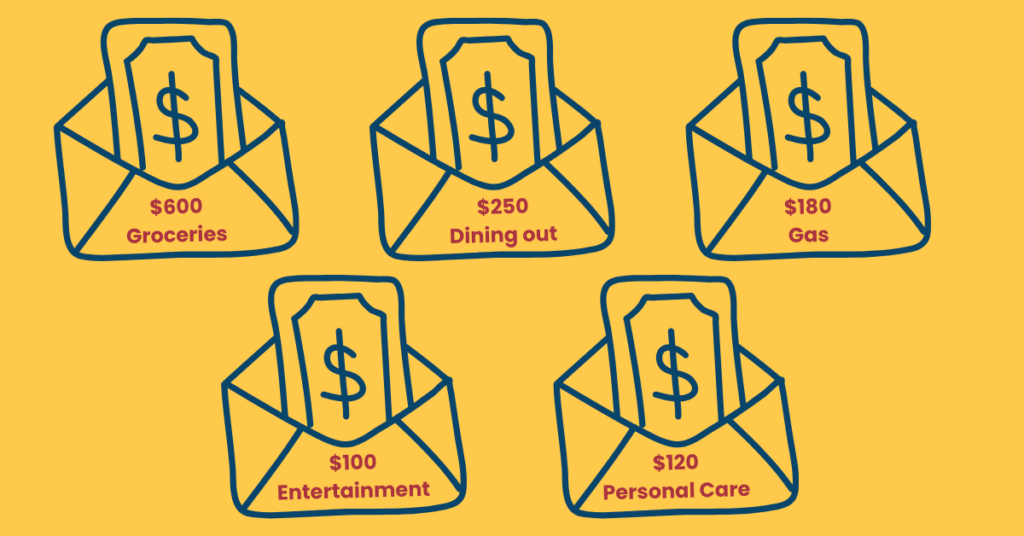
Swiping a card never feels like real money. Watching your grocery envelope get thin? That feels very real.
The modern version — called cash stuffing — uses labeled pouches or binder systems and has become its own community online. People track it, decorate it, and swear by it.
The limitation: You can’t pay rent or online bills with cash envelopes. Most people apply this method only to variable spending (groceries, dining, shopping) and handle fixed bills separately.
How to Choose the Right Method
Not sure which one fits you? Answer these honestly:
| Question | If Yes, Try… |
|---|---|
| Do you want something simple with minimal tracking? | 50/30/20 or 80/20 |
| Do you struggle to save no matter what? | Pay Yourself First |
| Do you overspend on specific categories? | Envelope / Cash Stuffing |
| Do you want to know exactly where every dollar goes? | Zero-Based Budgeting |
And here’s the thing: you don’t have to pick just one. Plenty of people use 50/30/20 as their big-picture guide and cash stuffing for the categories where they tend to go overboard. Hybrid approaches are completely valid.