
Last updated on September 9th, 2026 at 02:09 am
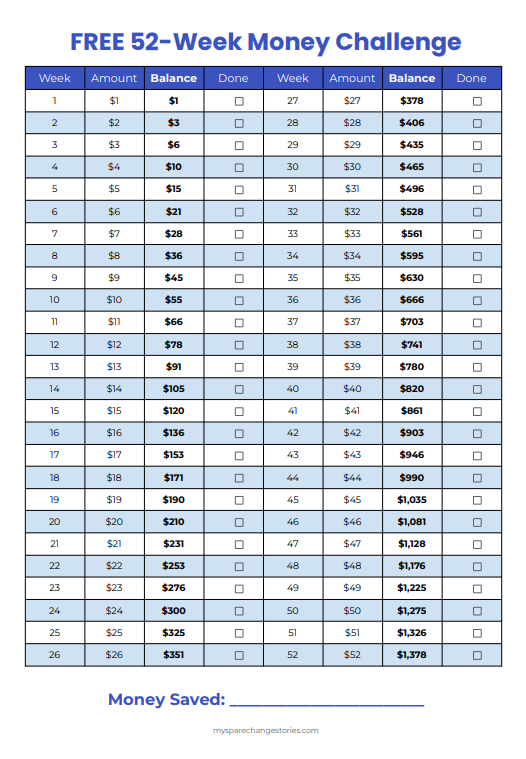
The 52-week money challenge is a simple way to save money over one year. The classic version starts with saving $1 in the first week, $2 in the second week, and continues increasing the amount by $1 each week until you save $52 in week 52. If you complete the full challenge, you’ll have $1,378 saved.
That sounds pretty manageable when you’re looking at the first few weeks. Saving $1 or $5 doesn’t require much thought. By the end of the year, though, putting aside $50 or more in one week can be a different story. That’s why you don’t have to treat $1,378 as the only way to do the challenge. You can choose a weekly amount that fits your budget, try a reverse version, or turn the 52 weeks into 52 small money-saving activities.
What Is the 52-Week Money Challenge?
The classic 52-week challenge asks you to save a little more each week for 52 weeks.
It looks like this:
- Week 1: $1
- Week 2: $2
- Week 3: $3
- Week 4: $4
- Week 5: $5
- …
- Week 52: $52
By adding all 52 weekly amounts together, you get $1,378.
The idea is simple enough that you don’t need a complicated spreadsheet or a special savings product. You can keep track of your progress with a notebook, spreadsheet, savings tracker, or a separate savings account.
The bigger question is whether the classic version works for your budget.
How Much Money Do You Save With the 52-Week Challenge?
If you follow the traditional version from $1 to $52, you’ll save $1,378 over 52 weeks.
The calculation is:
$1 + $2 + $3 + … + $52 = $1,378
The weekly amounts add up gradually, so the beginning of the challenge is very light. The later weeks require larger deposits.
For example, you’ll save $10 in week 10, $25 in week 25, and $52 in the final week. Looking at the whole year can make $1,378 sound like a large target, while looking at one week at a time makes the challenge easier to understand.
How Much Should You Save Each Week?
There isn’t one weekly amount that works for everyone. Your income, bills, existing savings, debt payments, and other expenses all affect what you can reasonably put aside.
If the classic challenge doesn’t fit your budget, a fixed weekly amount can be easier to plan.
| Challenge | Weekly Saving | Total After 52 Weeks |
|---|---|---|
| Easy | $10 | $520 |
| Steady | $25 | $1,300 |
| Classic | $1–$52 | $1,378 |
| Bigger Goal | $50 | $2,600 |
| Double Classic | $2–$104 | $2,756 |
The $25-a-week version is particularly close to the classic challenge in total, although the deposits stay the same throughout the year.
A $10 weekly challenge gives you a lower target of $520, while $50 a week brings the total to $2,600. There’s no rule saying your 52-week challenge has to follow the traditional $1-to-$52 pattern.
The Classic 52-Week Savings Challenge + Free Printable PDF
Here’s the traditional schedule if you want to follow the challenge exactly.
Try a Random 52-Week Challenge
The traditional challenge tells you exactly how much to save each week. A random version adds a little mystery.
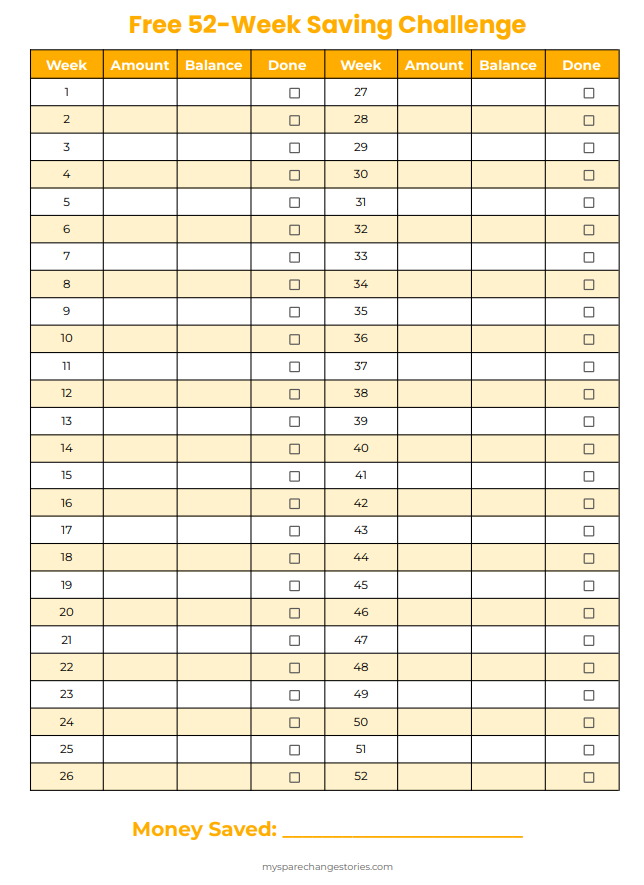
Write the numbers $1 through $52 on separate pieces of paper, or use a random number generator. Each week, pick one amount and save it. Cross that number off your list so you don’t use it again.
You’ll still save $1,378 if you use every amount from $1 to $52 exactly once.
The difference is that you won’t know whether next week will be a $7 week or a $49 week.
That can make the challenge more interesting, although you’ll want to check your budget before committing to a larger amount.
Need More Ways to Save?
Find money-saving ideas, challenges, and useful tools that can fit different budgets and goals.
See More Saving Ideas →What About the Reverse 52-Week Challenge?
The reverse 52-week challenge works in the opposite direction.
Instead of starting with $1 and ending with $52, you start with $52 in week 1 and reduce the amount by $1 each week until you reach $1 in week 52.
The total is still $1,378.
This version can make sense for someone who prefers putting more money aside earlier in the year. The first few weeks require more money, while the final weeks become much lighter.
For example:
- Week 1: $52
- Week 2: $51
- Week 3: $50
- …
- Week 50: $3
- Week 51: $2
- Week 52: $1
It’s the same total with a completely different schedule.
What If $52 Is Too Much for One Week?
There’s no reason to force the classic challenge if the later amounts don’t fit comfortably into your budget.
You could save $10 every week and finish with $520. Saving $25 every week gives you $1,300. Saving $50 every week gives you $2,600.
You could also change the amount during the year. For example, you might save $10 a week for the first few months, then increase it when your budget has more room.
The 52 weeks are simply a time frame. You can decide what amount belongs inside that time frame.
What If You Miss a Week?
Life has a habit of ignoring savings challenges.
An unexpected bill, a busy month, a higher grocery bill, or a week where your budget is already stretched can happen. Missing one deposit doesn’t erase the money you’ve already saved.
If you miss a week, you can simply continue with the next scheduled amount. You can also spread the missed amount across several later weeks rather than trying to put everything back at once.
For example, if you missed a $20 deposit, adding about $7 to your savings over the next three weeks would roughly make up the difference.
You can also leave the missed amount alone and finish with a smaller total. The challenge doesn’t have to become another bill hanging over your head.
Can You Start the 52-Week Challenge at Any Time?
Yes. The challenge doesn’t have to begin on January 1.
You can start whenever you’re ready and treat your first week as Week 1. If you start halfway through the year, you can still complete 52 weeks by continuing into the following year.
Another option is to adjust the weekly amounts based on the time you have available. There’s nothing special about a calendar date when it comes to putting money aside.
You might also like: Unhinged but Legal Ways to Actually Save Money
What Could You Do With $1,378?
If you complete the classic challenge, you’ll have $1,378 set aside.
That money could have different jobs depending on your situation. You might put it toward an emergency fund, a future trip, a large annual expense, debt payments, a car fund, or another savings goal.
You could also divide it between several goals.
For example:
- $700 toward an emergency fund
- $300 toward a travel fund
- $200 toward a future bill
- $178 toward a personal savings goal
The important part is knowing what you want the money to be for before you reach the end of the challenge.
Make the 52-Week Challenge Your Own
The classic $1-to-$52 challenge is easy to understand, which is probably why it has stayed popular. Still, you don’t have to follow it exactly.
You can save a fixed amount every week, reverse the schedule, choose random amounts, or create your own 52 weekly money challenges.
You could even do the challenge with a partner or friend and compare your progress without making it a competition. One person might be saving $10 a week while another is working through the classic challenge.
One Year, One Savings Goal
The appeal of the 52-week challenge is really in watching the small amounts add up. $1 doesn’t look like much sitting on its own, and neither does $5 or $10. Put those weekly deposits together over a year and the numbers look very different.
Whether you finish with $520, $1,378, $2,600, or another amount entirely, the challenge can be whatever you make of those 52 weeks. You can keep it traditional, make it random, give each week its own little money challenge, or change the rules when your budget changes.
A savings challenge doesn’t need to be perfect to be useful. It just needs to give your money somewhere to go.