

Last updated on September 7th, 2026 at 01:05 am
I picked up my usual bag of chips last week and flipped it over without really thinking. Same price as always, but there was noticeably less inside. My cereal has been doing the same thing for months, and don’t even get me started on olive oil. At some point, grocery shopping for two stopped feeling like a normal errand and started feeling like a real hit to my budget.
If you’re wondering whether you’re spending too much or just trying to figure out what normal even looks like right now — most couples spend somewhere between $500 and $820 a month, with the middle ground sitting around $650 to $720. The right number depends on where you live, what you eat, and what you’re working with. Here’s how to figure out yours.
What the Data Actually Says About the Average Grocery Bill for 2 Adults
The most reliable reference point is the USDA’s monthly Cost of Food report, which publishes spending estimates across four budget tiers: Thrifty, Low-Cost, Moderate-Cost, and Liberal. These are designed around nutritious, home-cooked diets and get updated regularly, making them the most credible benchmark available for households anywhere in the world that uses a dollar-equivalent cost of living.
For a two-person household in 2026, here’s what the USDA moderate-cost plan looks like when you break it down by gender combination — because it does matter, since caloric needs vary:
| Household Type | Thrifty | Low-Cost | Moderate | Liberal |
|---|---|---|---|---|
| 1 Man + 1 Woman | ~$460 | ~$590 | ~$720 | ~$900 |
| Two Men | ~$510 | ~$650 | ~$780 | ~$970 |
| Two Women | ~$410 | ~$530 | ~$660 | ~$820 |
These figures are for groceries only — food purchased and prepared at home. They don’t include takeout, delivery fees, or the random $8 coffee you grabbed at a café or convenience store.
If you’re trying to build a realistic monthly food budget for a couple, it helps to keep your grocery spending and eating-out spending in separate buckets. (More on that in a moment.)
Quick benchmark: A moderate-cost grocery budget for two people averages around $650–$720/month, or roughly $160–$180/week. That’s a useful starting point before you adjust for your location and lifestyle.
Factors Influencing Your Grocery Bill
No two households spend exactly the same amount on groceries, even when the income and household size match. Several factors can push your number significantly above or below the average — and understanding them is more useful than chasing a single “right” figure.
Where you live. Geography is one of the biggest cost drivers. The same basket of groceries can run 20–40% more in high-cost cities like New York, San Francisco, or London compared to mid-sized Midwestern cities. Households in Hawaii or major coastal metros regularly report grocery bills closer to $900–$1,200 for two, while couples in smaller cities or rural areas often manage a full, varied diet well under $600 a month.
What you eat. Diet composition has a major impact. A household that relies heavily on fresh meat, wild-caught seafood, and organic produce will routinely land at the liberal end of the USDA scale. A mostly plant-based diet built around legumes, eggs, grains, and seasonal vegetables can comfortably sit in the thrifty to low-cost range — often $200–$300 less per month for the same number of people.
Caloric and nutritional needs. Two people with very different caloric requirements — say, one partner who lifts weights regularly or has a physically demanding job — will spend more than the averages suggest, even when meal planning carefully. This isn’t inefficiency; it’s just the reality of higher energy needs.
Store choice. Where you shop matters almost as much as what you buy. Discount grocery chains, warehouse stores, and budget-oriented supermarkets can run 20–35% cheaper than premium grocers for comparable products — a bag of lentils doesn’t taste better just because Erewhon sold it to you for $14. Households that split their shopping across store types often see meaningful savings without changing what they eat.
Food waste. The average household throws away a significant portion of what it buys each month. Produce that goes bad before it’s used, leftovers that don’t get eaten, and pantry items that expire quietly all add to the effective cost per meal. Reducing waste is one of the higher-leverage ways to lower a grocery bill without changing the menu.
Household habits and routines. Meal planning, batch cooking, and shopping with a list consistently lead to lower bills than unplanned shopping or frequent small top-up trips. Convenience items — pre-cut vegetables, single-serve packaging, ready-to-heat meals — are also priced at a premium that compounds across a month.
Dietary restrictions and health needs. Gluten-free, allergen-free, or medically necessary specialty foods often carry a significant price premium over their conventional equivalents. Households with these needs should build that into their baseline rather than benchmarking against a general average.
What Two People Are Actually Spending (Real Household Data)
Beyond the averages, households across different income levels report a surprisingly wide range.
A couple in a lower cost-of-living area who meal preps and shops at discount stores can comfortably eat well for $400–$500 a month.
A couple in an expensive city who prioritizes organic produce, specialty items, or a high-protein diet can easily land at $1,000–$1,200 — and still be cooking every meal at home.
One household shared that despite shopping at multiple stores to find deals, their monthly bill for two ran over $1,000 partly because one partner lifted weights and needed significantly more calories than average. That’s not waste — it’s just reality when caloric needs are higher.
The average grocery cost for 2 people per week works out to about $130–$185 on a moderate plan, though plenty of households report spending anywhere from $80 to $300+ weekly depending on diet type, store choice, and how much cooking they actually do at home.
How Much of Your Income Should Go to Groceries?
A reasonable rule of thumb is to keep grocery spending within 10–15% of your monthly take-home pay. So if you and your partner bring home $5,000 a month combined, a grocery budget of $250–$375 per person — or $500–$750 total — sits right in that range. At $8,000 a month, you’ve got more room to work with, and $600–$700 total lands comfortably within a healthy budget without stretching anything.
The trouble is that most households don’t separate groceries from household supplies, which makes their numbers look higher than they are. Paper towels, cleaning products, and toiletries often sneak into the grocery total. If you’re wondering whether $600 a month is too much for groceries for 2, it’s worth pulling those non-food items out first before judging the number.
Useful check: If groceries are eating up more than 10–15% of what you both bring home each month, that’s worth a second look. And if your budget hasn’t been touched in a year or two, inflation has probably already made it feel off — prices are just higher now than when you last set those numbers. This guide on adjusting your budget for inflation helps you update your numbers without the headache.
💡 If you’re looking to understand budgeting better, take a look at our guides and tools for managing your money.
Explore Budgeting Calculators & GuidesGrocery Budget Breakdown by Category
One of the most useful things you can do is understand where your grocery money actually goes. Most two-person households spend across a fairly predictable set of categories, though the proportions vary a lot by diet.
| Category | % of Grocery Budget (Approx.) | Monthly Est. (at $650 total) |
|---|---|---|
| Proteins (meat, fish, eggs, legumes) | 25–30% | $160–$195 |
| Produce (fruit & vegetables) | 20–25% | $130–$162 |
| Dairy & alternatives | 10–15% | $65–$97 |
| Grains, bread, pasta, rice | 10–12% | $65–$78 |
| Snacks, beverages, condiments | 15–20% | $97–$130 |
| Frozen & canned goods | 8–12% | $52–$78 |
Protein is where most couples feel the pinch first. Swapping some meat-heavy meals for plant-based proteins — lentils, beans, eggs, tofu — can pull $50–$100 out of your monthly bill without meaningfully changing how satisfying or varied the meals feel. It’s one of the more effective budget grocery shopping tips that doesn’t require eating like you’re in a caloric deficit.
Groceries vs. Eating Out: The Number Most Couples Ignore
A grocery budget doesn’t exist in isolation. Most couples are also spending money on restaurants, coffee shops, takeout, and delivery — and those numbers add up faster than most people realize. If you’re spending $600/month on groceries and $400/month eating out, your total food spend is $1,000, which is on the higher side for two people. The question isn’t which number is “too high” in isolation — it’s whether the combined total fits your income and goals.
A reasonable benchmark for eating out on a couple’s budget runs anywhere from $100–$300/month depending on lifestyle. If you’d like to think through how to split or track that side of your food spending, this breakdown on how much to budget for eating out gives a useful frame.
Practical Ways to Bring the Number Down Without Eating Sad Food
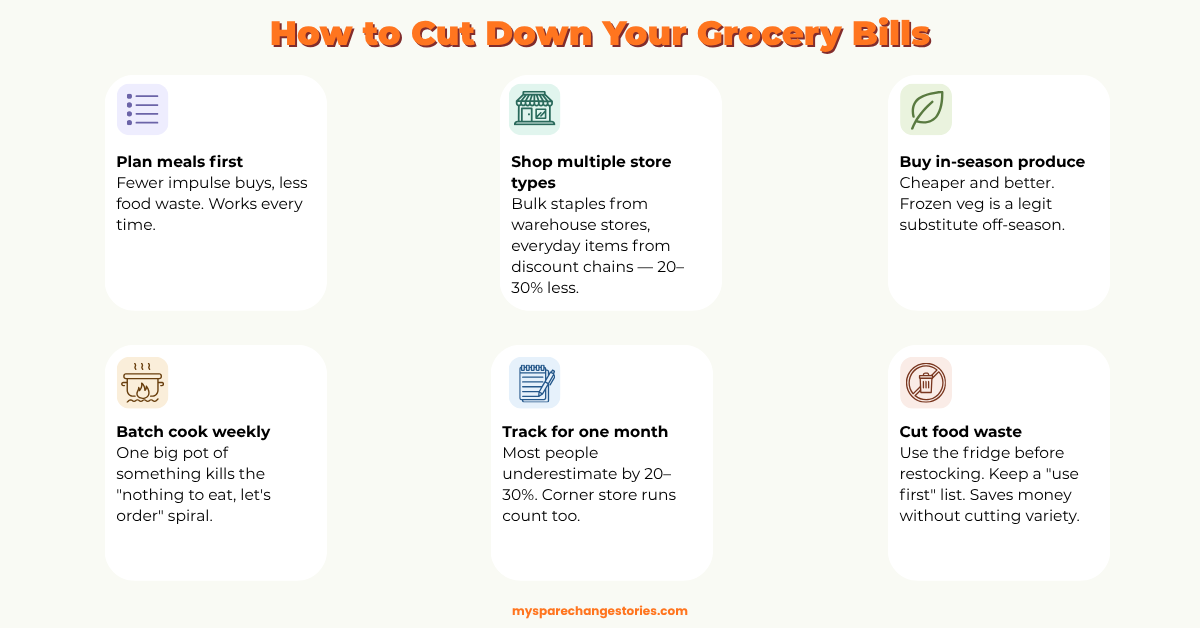
If your current grocery spend is running higher than you’d like, these are the adjustments that tend to make the biggest difference without requiring a complete lifestyle overhaul:
- Plan meals for the week before you shop. It sounds basic because it is, and it genuinely works — households that plan before shopping consistently report fewer impulse buys and less food waste, which is one of the quieter leaks in most grocery budgets.
- Shop at multiple store types. Warehouse stores work well for pantry staples and proteins bought in bulk. Discount grocery chains often carry the same brands at 20–30% less. Specialty stores are for the things you actually care about. Splitting the run between two or three store types can make a real dent.
- Buy produce that’s in season. It’s cheaper, it tastes better, and it usually means you’re cooking with whatever’s actually at peak right now. Frozen vegetables are a legitimate alternative for anything out of season — nutritionally comparable and significantly cheaper.
- Batch cook once or twice a week. Making a large pot of something — soup, grains, a protein — cuts down on the “there’s nothing to eat, let’s just order something” moments that quietly drain grocery budgets sideways.
- Track what you’re actually spending for one month. Not to judge it, just to see it. Most people underestimate their grocery bill by 20–30% because small runs to the corner store or convenience purchases don’t feel like “grocery shopping.”
- Reduce food waste actively. The average household throws away more than it realizes — and it’s rarely the big stuff. For me, it was the salad dressing bought for one recipe and the half-onion I was definitely going to use. I wasn’t. A quick fridge inventory before every grocery run fixed most of it — turns out half of what I thought I “needed” was already in there, slowly dying. Using what’s on hand before restocking, storing produce properly, and keeping a short “use first” list can meaningfully cut waste without changing what you actually eat.
For a deeper look at how to reduce your grocery bill without giving up the foods you actually enjoy, this guide on saving money on groceries covers specific strategies that go beyond the basics.
What’s a Reasonable Number for You?
There’s no universal right answer — a couple in rural Iowa and a couple in central London are living in entirely different grocery cost realities. Start with the USDA moderate-cost benchmark ($650–$720/month for two), adjust for your city and diet, and track what you actually spend for a month or two. You might be right on target. You might find you’ve been spending $200 more than you realized. Either way, knowing the number beats guessing.