

I remember when I was in college, I usually paid in cash because I didn’t have a credit card. I’d come home from university with a surprisingly heavy bag from all the coins I had collected during the day.
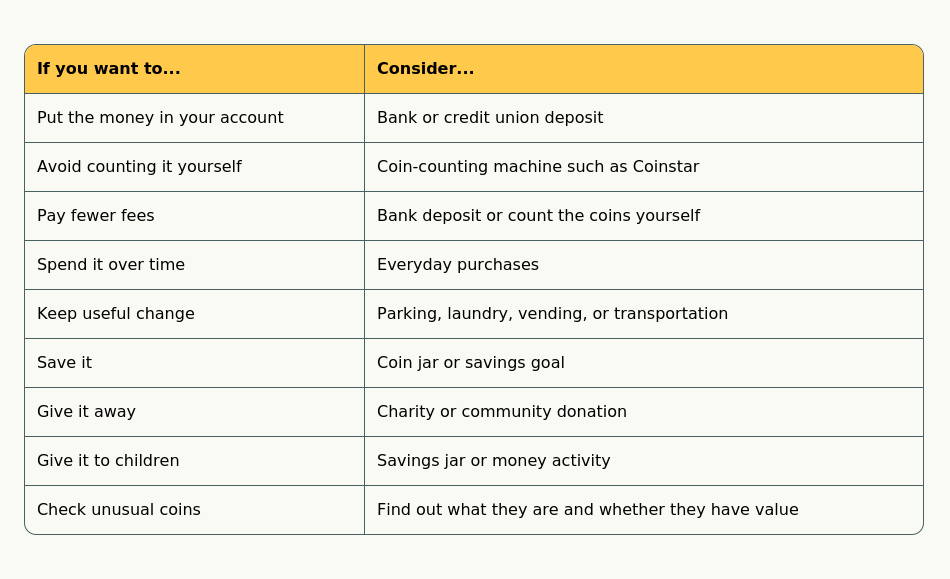
If you have a jar, bag, or drawer full of coins, you might be wondering what to do with coins. You can spend them, deposit them at a bank, use a coin-counting machine such as Coinstar, donate them, or save them for a goal. The best option depends on how many coins you have and what you want to do with them.
1. Deposit Your Coins at a Bank
One of the easiest answers to what to do with loose change is to deposit it into your bank account.
Banks have different rules for handling coins. Depending on the bank and location, you may be able to:
- Bring loose coins to the bank
- Sort the coins by type
- Put the coins into rolls
- Use a coin-counting machine
- Take your coins to a specific branch
If you have a lot of coins, check your bank’s rules before you go. You don’t want to carry a heavy bag of coins to the bank and then find out that you need to sort them first.
2. Use a Coin-Counting Machine, Such as Coinstar
If you have a large pile of coins and don’t want to count them yourself, a coin-counting machine can be a convenient option.
Coinstar is one of the better-known coin-counting services. Its machines are available at participating retail locations in certain countries. You pour your coins into the machine, let it count them, and then choose from the payment options available at that location.
Depending on the machine and location, you may be able to choose:
- Cash, which may have a processing fee
- Gift cards from participating retailers
- Other available payment options
Check the fee before using the machine. If you have a small jar of coins, paying for convenience may be worth it. If you have a few hundred dollars in coins, you may want to compare your options first.
Coinstar may also offer gift cards for certain retailers. In some locations, choosing a gift card can avoid the cash-processing fee. The available retailers and terms can vary, so check the options shown on the machine before making your choice.
3. Roll the Coins Yourself
Rolling coins takes more time, but it can be useful if your bank accepts rolled coins.
First, separate the coins by type. Then count them and put them into the correct coin wrappers based on your bank’s requirements.
The number of coins in each roll can vary depending on the currency, so check your bank’s instructions before you start.
If you have a large jar of coins, you can make this a simple weekend task. Put on a show or listen to a podcast while you sort and count. Counting the same type of coin over and over can get boring pretty quickly.
4. Spend Your Coins at Self-Checkout
Self-checkout can be an easy way to use your loose change when you’re already shopping.
For example, if you’re buying a few groceries, you can use some of your coins to pay for your purchase if the machine accepts them.
This can be especially useful when the machine has a coin slot that counts the coins for you.
Try to do this when the store isn’t busy. Emptying a large jar of coins while a long line is waiting behind you probably isn’t the best time to start counting.
5. Use Coins for Everyday Purchases
You don’t have to wait until your coin jar is completely full before spending the coins. They can be useful for small purchases when cash is accepted.
I usually keep coins around for vending machines, especially when I’m out and want a quick drink or snack. In some areas, you may also need a coin to unlock a grocery cart. You get the coin back when you return the cart, so keeping a few coins in your bag or car can be useful.
You could also use coins at:
- Convenience stores
- Food trucks
- Vending machines
- Laundromats
- Grocery store carts
- Parking meters
- Public transportation
- Tolls
- Small local stores
If you’re buying something inexpensive, paying with a few coins can help reduce the amount of change you carry around.
Just check that the business or machine accepts cash and coins because payment options can vary by location.
6. Put Your Spare Change Toward a Savings Goal
Instead of leaving spare change in a drawer, give your coins a clear purpose.
You could save them for:
- An emergency fund
- A vacation
- A birthday gift
- A sinking fund
- A small household purchase
- A savings challenge
You can keep a coin jar and move the money to your savings account once it reaches a certain amount.
The amount may be small at first, but a few coins are still money. You can add them to the savings you already have.
Need More Ways to Save?
Find money-saving ideas, challenges, and useful tools that can fit different budgets and goals.
See More Saving Ideas →7. Donate Your Coins
Donating is another simple solution for loose change, especially if you don’t want coins piling up at home.
Depending on what’s available in your area, you could donate to:
- Local charities
- Community organizations
- Schools
- Religious organizations
- Donation boxes
- Community fundraisers
You can donate whatever has collected in your coin jar instead of waiting until you have a large amount.
If you’re traveling and have leftover local coins that you can’t easily exchange, donating them before you leave can also be an option if you find a collection point that accepts them.
8. Give Your Coins to Kids to Teach Them About Money
Giving coins to children can be a simple way to teach them about money. They can learn how to recognize different coins, count money, save for something they want, and understand that small amounts can add up over time.
You could give spare coins to your children, nieces, nephews, grandchildren, or other young family members. They can:
- Sort coins by type
- Count how much they have
- Put them into a savings jar
- Choose what they want to save for
- Use a small amount to buy something
- Learn the difference between saving, spending, and giving
Children usually appreciate almost any form of money. Give them a few coins and suddenly that old coin jar becomes very important. You might even get a very serious report about how much money they have saved.
You can also turn the coins into a simple money activity. Ask the child to count the coins, set a small savings goal, or decide how much they want to save and how much they want to spend.
A physical coin jar can make money easier for children to see and understand. You could pair it with a three-jar budgeting method for kids, where money is separated into different purposes such as saving, spending, and giving.
For younger children, supervise them while they handle coins because coins can be a choking hazard.
9. Check Old, Foreign, or Unusual Coins First
Before spending or depositing all your coins, take a quick look through them.
Set aside anything that looks different from the coins you normally use, such as:
- Foreign coins
- Older coins
- Discontinued currency
- Unusual coins
- Commemorative coins
Most old coins aren’t automatically valuable. Still, if you have something unusual, it’s worth checking what it is before putting it into a coin-counting machine.
A foreign coin may not be useful in the country where you currently live, but that doesn’t mean it has no value. You can check whether it can be exchanged, saved for a future trip, or donated.
If you have a large collection of old or unusual coins, you can ask a reputable local coin dealer or specialist about their possible value.
10. Turn Your Coins Into a Small Savings Challenge
Your loose change can also become a simple savings challenge.
You could:
- Save all your coins for one month
- Save every coin of a certain type
- Empty your pockets into a jar each evening
- Set a savings goal for your coin jar
- Move the total into your savings account at the end of the month
You don’t need complicated rules. Just give your coins a place to go instead of letting them collect in random drawers and bags.
For example, you might decide to put every coin you receive into a jar for three months. At the end, count the money and decide whether you want to save it, spend it, or put it toward a specific goal.
Do Any Banks Accept Loose Coins?
Yes, banks can accept coin deposits, but the process depends on the bank and location.
A bank may:
- Accept loose coins
- Ask you to sort them
- Require coin rolls
- Provide a coin-counting machine
- Direct you to a specific branch
It’s best to check with your bank before bringing in a large amount of loose change.
If you’re already a customer, your bank’s website, app, customer service team, or local branch can usually tell you how they handle coin deposits.
A Simple Way to Deal With Loose Change
If you’re still wondering what to do with loose change, you don’t need to make it complicated.
Start by sorting through what you have. Set aside any old, foreign, or unusual coins that may need a closer look. Then decide what you want to do with the rest.
You can deposit them, count and roll them, use a coin-counting machine, spend them on everyday purchases, donate them, give them to a child, or save them for a specific goal.
For me, coming home from university with a heavy bag of coins is a good reminder that small amounts can add up without much attention. Those coins started as ordinary change from everyday purchases, then slowly turned into a bag that was surprisingly heavy by the time I got home.
If you have your own collection of loose change money, give it a purpose instead of letting it sit around indefinitely. Even a jar of coins can become spending money, savings, a donation, or a useful stash for the next time you need exact change.