Budgeting can feel like a whole extra job. You have to remember your bills, track your spending, plan for future expenses, and somehow keep everything organized.
And when you can barely remember what you had for dinner yesterday, remembering every little money detail can feel like a lot…
If you have ADHD, all that money stuff can get overwhelming pretty quickly. Your budget should take some of that work off your plate by keeping things simple, reducing the amount you need to track, and automating the stuff you tend to forget.
Why Is Budgeting Difficult With ADHD?
Adult life can already feel chaotic. There are bills, work, groceries, appointments, subscriptions, errands, and unexpected expenses to keep track of.
When you have ADHD, managing all of these responsibilities at once can make money management feel even more overwhelming. Budgeting can become another task that requires remembering, planning, and staying organized.
Managing money involves several tasks that can be difficult when executive functioning is a challenge.
You may need to:
- Remember when bills are due
- Keep track of multiple expenses
- Plan for expenses that happen weeks or months from now
- Delay purchases you want right now
- Keep track of subscriptions
- Remember to move money into savings
- Notice when small purchases are adding up
This can make a traditional budget with lots of categories and constant tracking difficult to maintain.
The goal of budgeting with ADHD is to make your money system easier to follow when your attention, motivation, or memory isn’t cooperating.
Want to Get Better at Budgeting?
Find simple budgeting guides, tips, and useful calculators to help you plan your money and work toward your financial goals.
Budgeting Guides & Calculators →What Does an ADHD-Friendly Budget Look Like?
An ADHD budget should be easy to understand when you look at it.
You don’t need 30 categories unless you genuinely find that useful.
A simple setup could look like this:
That’s enough to start.
You can add categories later if you notice that a particular expense needs its own space.
The main idea is to make it obvious what your money is for.
How to Budget With ADHD
1. Start With Your Take-Home Income
Start with the amount that actually reaches your bank account.
For example, let’s say you bring home $4,000 per month.
You might divide it like this:
Your categories and amounts will depend on your own expenses.
The important part is knowing how much money is actually available after your regular commitments.
2. Automate Your Bills
If a bill happens every month, you probably don’t want to rely on remembering it every month.
Use automatic payments where they’re available and appropriate for your situation.
This can include:
- Rent or mortgage
- Utilities
- Insurance
- Loan payments
- Phone bills
- Regular subscriptions
If you get paid monthly, you might also prefer to have recurring bills scheduled around the beginning of the month, provided the timing works with your income and due dates.
The fewer recurring payments you have to remember manually, the fewer things are competing for your attention.
3. Automate Your Savings
The same idea works for savings.
If you want to save $400 every month, you could schedule an automatic transfer after payday.
For example:
Income: $4,000
Automatic savings: $400
The $400 moves to savings before you start treating the remaining money as available for everyday spending.
You don’t have to remember to save it later.
4. Separate Your Bills, Spending, and Savings
Seeing one large bank balance can make it difficult to tell how much money is actually available.
Imagine your account shows:
$4,000
It might look like you have plenty of money.
But perhaps:
- $1,500 is needed for bills
- $500 is for groceries
- $400 is going to savings
- $600 is available for personal spending
- $300 is your buffer
You could separate these amounts using different accounts or clearly separated money spaces, depending on what your bank offers.
For example:
You don’t need multiple accounts if they make your finances harder to manage. The setup should make your money easier to understand, not create another organizational project.
Related Post: How to Budget with Multiple Bank Accounts
5. Give Yourself a Weekly Spending Amount
Monthly spending can be difficult to visualize.
Imagine you have $400 set aside for personal spending each month. At the beginning of the month, $400 might seem like plenty. Then you buy takeout, grab a few coffees, order something online, go out with friends, and pay for a couple of small extras.
Those purchases can add up faster than you expect.
A weekly amount can make the money easier to keep track of:
$400 ÷ 4 weeks = $100 per week
Now, instead of thinking, “I still have $400,” you can ask:
“How much of my $100 weekly spending amount have I used?”
Your $100 could go toward things like:
- One restaurant or takeout meal
- Coffee and snacks
- A movie or other entertainment
- A small online purchase
- Hobbies
- Personal treats
You don’t need to spend exactly $100 every week. You might spend $70 one week and $120 the next. The weekly amount simply gives you a shorter window to work with, so you’re less likely to lose track of how much you’ve spent.
You might also like: How to Budget When You Get Paid Weekly
6. Add Friction Before Impulse Purchases
Online shopping makes it incredibly easy to buy something before you’ve had time to think about it.
You see a $60 item.
You click Buy Now.
Done.
One way to handle this is to make the process slightly less convenient.
You could:
- Remove saved payment details from shopping websites.
- Turn off shopping notifications.
- Unsubscribe from promotional emails.
- Put items in your cart instead of buying immediately.
- Use a 48-hour waiting period for larger non-essential purchases.
- Delete shopping apps from your phone.
- Keep savings separate from your everyday spending account.
The point isn’t to make spending impossible.
It’s to create a little time between wanting something and paying for it.
If you notice that certain purchases happen because you’re bored, stressed, excited, or looking for something interesting to do, understanding impulse buying can help you recognize those patterns.
7. Keep Savings Slightly Harder to Access
Your savings should still be available when you genuinely need them.
You can simply make it less convenient to spend accidentally.
For example, you could keep your savings in a separate account without an everyday debit card attached to it.
If you want to buy a $25 item, you can’t simply tap your savings card.
You’d have to transfer the money first.
That extra step gives you a chance to decide whether the purchase is actually worth taking money away from your savings.
I wouldn’t recommend giving another person access to your savings simply to prevent yourself from spending. Keeping control of your own account while adding reasonable friction is a simpler approach.
8. Budget for Fun
A budget doesn’t need to eliminate everything you enjoy.
If your budget only contains bills, groceries, debt payments, and savings, you may eventually want to spend money on something fun.
Give it a place in the budget.
For example:
Personal spending: $300 per month
That could cover:
- Eating out
- Coffee
- Movies
- Games
- Hobbies
- Clothes
- Small treats
You can spend it without wondering whether every enjoyable purchase has “ruined” your budget because the category already exists.
Looking for more tips? Read: How Much Should You Budget for Discretionary Spending?
9. Keep a List of Non-Shopping Treats
Sometimes you want something interesting to happen rather than actually wanting to buy something.
Shopping happens to be an easy option.
Keep a list of activities you enjoy that don’t require spending money.
For example:
- Watch a comfort show
- Play a video game
- Go for a walk
- Try a new recipe
- Call a friend
- Read
- Work on a hobby
- Take photos
- Rearrange your room
- Make coffee at home
Keep the list somewhere visible, such as your phone.
You don’t need a complicated productivity system for it.
10. Make Your Budget Easy to See
Your budget doesn’t have to live inside a giant spreadsheet.
You could use a phone note:
August Budget
Income: $4,000
Bills: $1,900
Savings: $400
Groceries: $500
Spending: $700
Buffer: $500
That’s it.
You can use an app, spreadsheet, paper planner, or whatever format you are most likely to check.
If you have to click through five screens just to find your spending balance, the system may be doing too much.
11. Use a Simple ADHD Budget Template
An ADHD budget template can be very simple.
You don’t need to track every individual transaction if detailed tracking makes the budget difficult to maintain.
There isn’t a prize for having the most detailed spreadsheet.
12. Use Reminders for the Things You Can’t Automate
Not everything can be put on autopilot.
You may need to renew insurance, review a subscription, pay an annual fee, or complete a financial task manually.
Put those dates in your calendar.
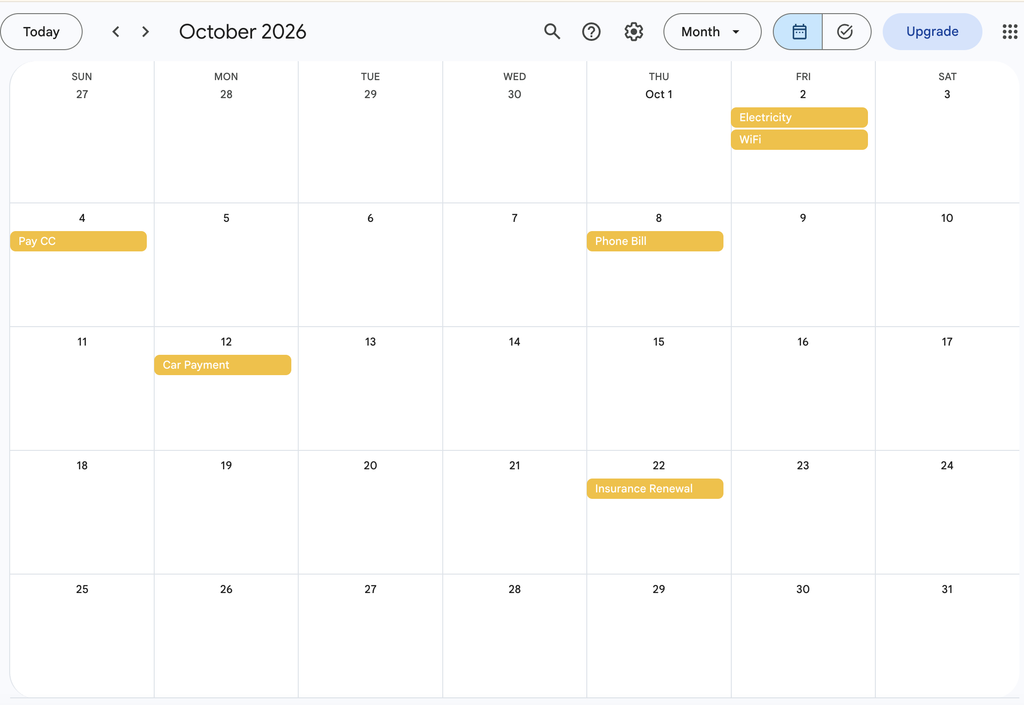
The same idea can work for a weekly money check.
13. Keep a Small Buffer
A budget based on exact numbers can leave very little room for real life.
You may need a replacement charger.
You may get invited to dinner.
You may need medicine.
Your pet may decide that the veterinarian is their new favorite destination.
A buffer gives these expenses somewhere to go.
For example, you might keep $200 to $300 in your monthly budget for expenses that don’t fit neatly into your normal categories.
If you don’t use it, the money can remain there or go toward a savings goal.
14. Check Your Money Once a Week
You don’t need a two-hour financial review.
A short weekly check can cover the basics.
Look at:
- Current balance
- Upcoming bills
- Remaining spending money
- Recent unusual purchases
- Savings balance
That’s enough to get a quick picture of what’s happening.
If your weekly spending amount is $150 and you’ve already spent $120, you know you have about $30 left for the week.
You don’t need to analyze every transaction unless there’s a specific reason to.
What If You Overspend?
Let’s say your weekly spending limit is $150.
You spend $190.
You can simply record the extra $40 and look at the rest of the month.
Maybe you reduce the next week’s spending amount.
Maybe the $40 comes from your buffer.
Maybe you decide that $150 wasn’t realistic and increase the category next month.
One overspending episode doesn’t need to turn into abandoning the entire budget.
The budget is there to show you what’s happening with your money, including when your original estimates don’t match real life.
Keep reading: What to Do When You Go Over Budget
Why Do People With ADHD Spend a Lot of Money?
ADHD can involve impulsivity, difficulties with delayed gratification, and challenges with planning and organization. These can affect financial decisions, although ADHD doesn’t automatically mean that someone will overspend.
There can also be a big difference between an immediate purchase and a future financial goal.
A $30 purchase gives you something now.
Saving that $30 for an emergency fund gives you a benefit that may be much further away.
Shopping can also become connected to boredom, stress, excitement, or other emotional situations.
If you notice that your spending changes depending on how you’re feeling, learning more about emotional spending can help you understand that pattern alongside your budget.
Which Budgeting Method Works With ADHD?
You don’t have to follow one budgeting method exactly.
You can take the parts that fit your life.
50/30/20 Budget
This divides money between needs, wants, and savings or debt payments.
It’s a simple framework when you don’t want a long list of categories.
Weekly Budget
You set a spending amount for each week rather than managing one large monthly amount.
This can make discretionary spending easier to visualize.
Zero-Based Budget
You give every dollar a purpose before the month begins.
It can work well if you like detailed planning, although it requires more tracking than a simple bucket system.
Pay-Yourself-First Budget
You move money into savings before treating the remaining money as available for spending.
Automatic transfers can make this easier to maintain.
Make Your Budget Fit Your Real Life
A budget doesn’t have to be complicated to be useful.
Your bills can be automated.
Your savings can move automatically.
Your spending money can have its own account or category.
Your larger impulse purchases can have a waiting period.
Your reminders can live in your phone instead of your memory.
And your budget can include fun because you’re a person, not a spreadsheet.
If you enjoy having a visible savings goal, a 52-week money challenge can also be one way to make saving more concrete.
The point of an ADHD-friendly budget is to make your money easier to understand and manage without requiring you to remember everything, track everything, or make dozens of financial decisions every day.