

You don’t need to be a financial wizard or stash away piles of cash to start saving. Sometimes, all it takes is a humble $5 bill to kick off a savings habit that actually sticks.
That’s the whole idea behind the $5 savings challenge: you just tuck away $5 whenever you spot a little extra in your wallet (or bank account), keep tabs on your progress, and watch your savings grow.
There’s no stopwatch ticking, so you get to save at your own pace. And if you’re in the mood for even more ways to trick yourself into saving, I’ve got a whole list of money-saving challenges waiting for you.
What Is the $5 Savings Challenge?
The $5 savings challenge is basically the low-pressure way to save: just set aside $5 whenever you can swing it.
No need to stress about saving every day or week—just stash $5 whenever you’ve got it, and jot it down somewhere so you can see your progress.
Here are some examples of what you can save:
| Number of deposits | Total savings |
|---|---|
| 20 | $100 |
| 50 | $250 |
| 100 | $500 |
| 200 | $1,000 |
It’s a good starting point if you want to build a savings habit without committing to a fixed monthly amount.
How to Do the $5 Savings Challenge
Getting started is about as easy as finding a reason to procrastinate—here are five steps to get you rolling:
1. Set a savings goal
Pick a savings goal that feels doable. Maybe you’re aiming for $100, or maybe you want to go big with $500. Whatever number you pick, make sure it won’t make your wallet cry.
2. Decide how to track your savings
You can keep track with a notebook, a spreadsheet, your phone’s notes app, or one of my printable trackers if you like things a little more official.
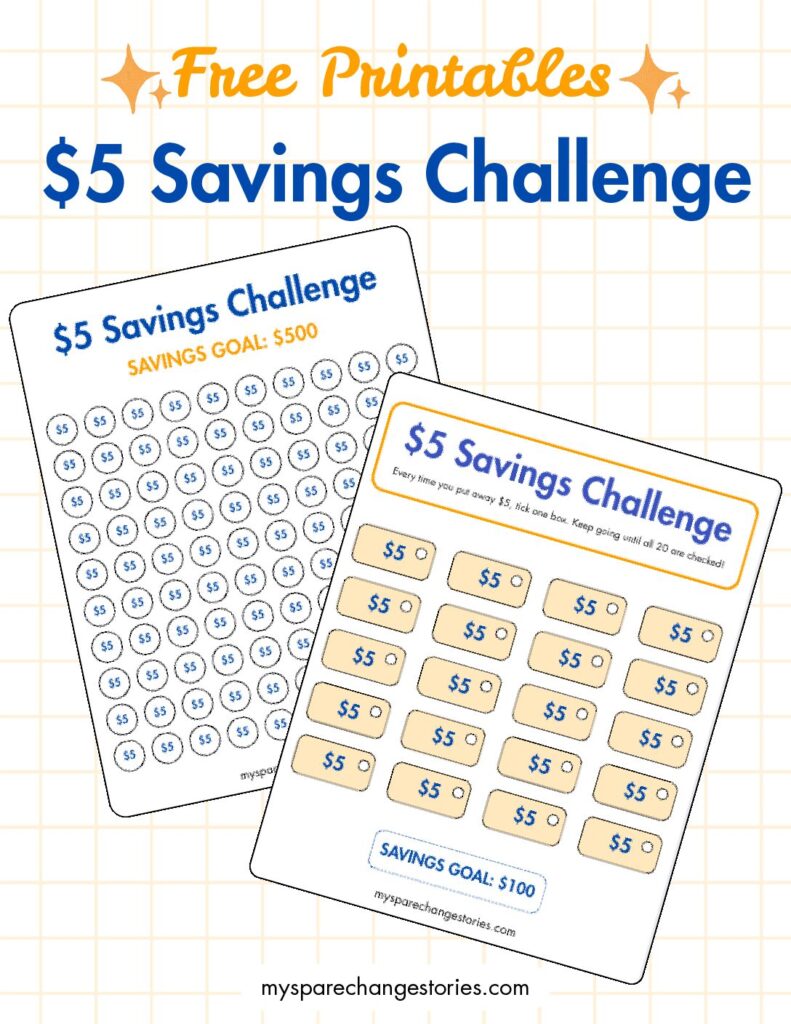
If you prefer something visual, I’ve created two free printables:
- $100 Savings Challenge: 20 boxes, each worth $5.
- $500 Savings Challenge: 100 circles, each worth $5.
3. Save $5 whenever you can
Whenever you have an extra $5, put it aside. There’s no need to follow a daily schedule. Just make sure your essential expenses are covered first.
4. Record your deposits
Mark down every $5 you save. If you’re using a printable, go wild with the coloring—one box or circle per deposit.
5. Reach your goal
Once you hit your goal, you get to decide: spend it on what you planned, or roll right into another challenge if you’re on a savings streak.
If you enjoy having a more structured savings schedule, you might also like the 52-week money challenge, where your savings build up over the course of a year.
Where Should You Keep Your Savings?
You have a few options depending on how you prefer to manage your money:
- Savings jar: Keep your cash somewhere visible so yoCash envelope: Slap a label on an envelope and stash your $5 bills there. If you’re feeling extra, the 50-envelope savings challenge is another fun way to get organized.anised, envelope-based approach.
- Separate savings account: Transfer your money into a dedicated account to keep it away from everyday spending.
If you’re keeping cash at home, make sure it’s stored somewhere safe.
What If You’re Cashless?
No need to hunt down actual $5 bills—you can totally do this challenge digitally too.
Got an extra $15? Just move it to your savings account and mark off three $5 deposits on your tracker. Easy math, no calculator required.
You can also use your bank’s savings features or a digital wallet that supports separate savings balances.
The important thing is to actually set the money aside, not just record it.
What Should You Do With the Money You Save?
Before you start, it helps to have a plan for your savings. Here are a few ideas to get your wheels turning:
- Emergency fund: Put your savings towards unexpected expenses.
- Holiday fund: Save for accommodation, food and travel expenses.
- Debt repayment: Use the money to pay down outstanding debt, especially if it carries high interest.
- Personal purchases: Work towards buying something you’ve been wanting, such as a new phone or Kindle.
- Future savings goals: Once you finish, you can always level up and try a bigger challenge next time.
You can also give a no-spend challenge a whirl if you want to cut back on impulse buys and boost your savings even more.
Having a clear goal makes it way easier to stay motivated—otherwise, it’s just a pile of fives with no mission.
Pros and Cons of the $5 Savings Challenge
Like any savings method, this challenge has its advantages and limitations.
Pros:
- Easy to start, even with a small budget.
- Flexible, since you can save whenever you have extra money.
- Helps you build better saving habits.
- Makes it easy to track your progress.
- Doesn’t require complicated budgeting tools.
Cons:
- Reaching your goal can take time if you save occasionally.
- At first, those little $5 deposits might feel like they’re not doing much.
- If your savings are too easy to grab, you might find yourself dipping in for a coffee run.
- It may not be enough on its own for bigger financial goals.
The challenge is best used as a starting point for building your savings, rather than your entire financial plan.
How to Start Your $5 Savings Challenge Today
You don’t need a complicated budget or a strict savings schedule. Start with a goal, choose where to keep your money and put away $5 whenever you can.
To make things even easier, I’ve whipped up two free printable trackers for you:
Free $100 Savings Challenge Printable
Save $5 for every box you complete. Fill all 20 boxes to reach your $100 goal.
Free $500 Savings Challenge Printable
Save $5 for every circle you complete. Fill all 100 circles to reach $500.
You can print them, keRemember, there’s no rush. Save at your own pace and give yourself a high five for every small win.our own pace and celebrate the small wins along the way.
Because honestly, every little bit really does count.