
Saving a set amount every two weeks is easier when you know exactly how much to save and what you’re saving for. A biweekly savings challenge gives you a schedule to follow. It could be as simple as saving for an emergency fund, a holiday, or a future purchase.
Another reason I like these challenges is that they make saving money far more enjoyable than it might seem at first glance (it’s not really something you want to add to your to-do list, is it?). I’m a visual person, so seeing your progress helps a lot. This guide explains how a biweekly savings challenge works, offers several ways to save, and includes a free printable to track your deposits.
What is a biweekly savings challenge?
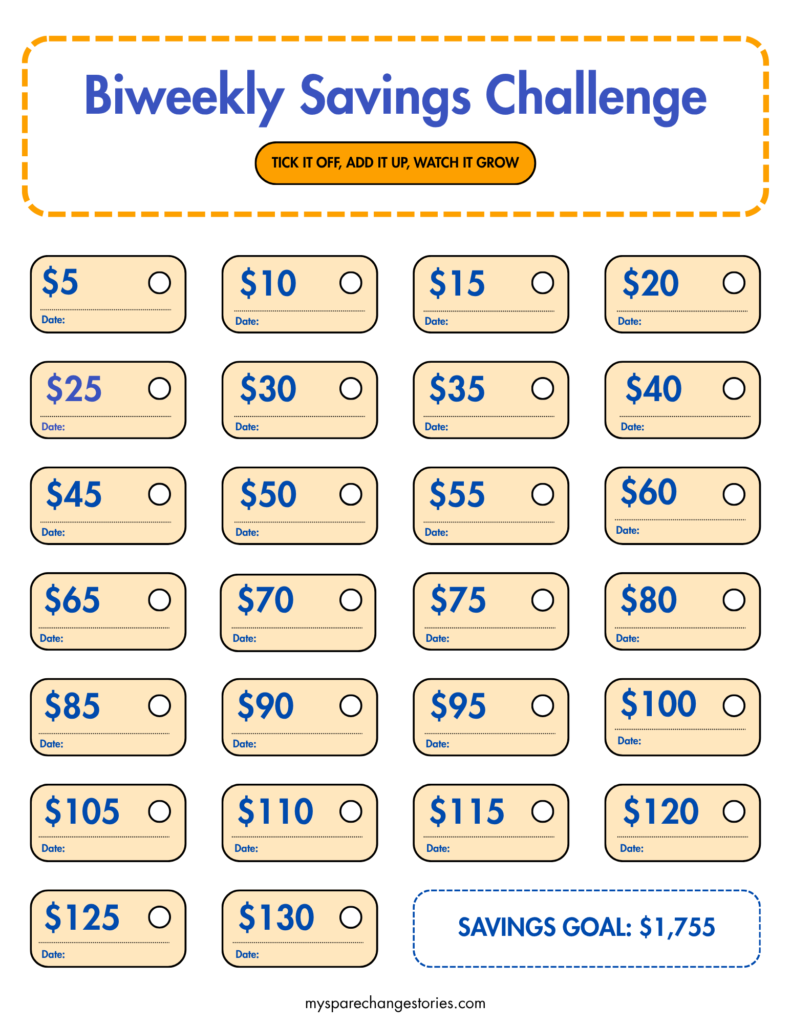
A biweekly savings challenge is a plan where you save a set amount every two weeks, follow a schedule, and track your progress along the way.
If you save $30 every two weeks, you’ll have $780 after 26 deposits, and if you can manage $60 each time, you’ll reach $1,560 in a year.
I like savings challenges with a clear number attached, since “I’ll save more this month” is easy to say and just as easy to forget once the bills start coming in. A set schedule gives you something concrete to follow, and a visual tracker lets you see how far you’ve come.
Biweekly means every two weeks, which adds up to 26 deposits a year, while saving twice a month adds up to 24. Bimonthly is trickier because it can mean twice a month or once every two months, so it helps to spell out your schedule when you set up your challenge.
How does a biweekly savings challenge work?
Start by establishing a savings goal and working out how much you can put away every two weeks. You can save the same amount each payday or vary your deposits according to your budget.
Let’s say you want to save $1,800 in a year. Spread that across 26 deposits, and you’re looking at approximately $69.24 every two weeks. You could round that up to $70 and finish the year with $1,820 (assuming you make all 26 deposits and don’t take any out).
Here’s how different deposit amounts can add up:
These figures don’t include any interest or investment income.
You don’t need to start with a big sum to make a savings challenge worthwhile. Pick a figure that works with your own income and outgoings, and then you can always increase it later if your budget permits.
How to Start a Biweekly Savings Challenge
You can set up a money-saving challenge in a few simple steps.
1. Choose a Savings Goal
Work out what you’re saving for first before you even think about how much you’re going to put down. It could be an emergency fund, it could be holiday expenses, it could be a holiday, it could be a new laptop, it could be something you’re going to buy in the future.
Having a clear objective makes it far easier to work out how much you need to save and gives you a reason to persist.
2. Pick an Affordable Amount
Review your normal running expenses, your debt repayments and any other savings commitments prior to deciding on an amount.
The amount that looks good in a savings challenge isn’t necessarily the amount that will work in a real budget. There’s a difference between the amount you can happily put aside and the amount which will ultimately mean you have to put off one of your bills just to make the numbers work.
If you can only afford $10 or $25 every two weeks, then start there. You can always tweak your deposits later on.
3. Decide When and Where to Save
If you’re getting paid every two weeks, you could, of course, transfer your savings after each payday. Having the money in a separate savings account is another way of making it easier to keep track of your progress without it getting mixed in with your regular spending money.
Just pick a method that works for you and fits in with your routine so you don’t have to remember some complex schedule.
4. Track Your Deposits
Use a printable, a spreadsheet, or a notes app to record each deposit. I personally prefer a visual tracker so I can tick each deposit off as I go. That keeps me engaged.
Seeing the finished boxes or the recorded amounts gives you a very clear idea of how far you’ve got and how much you have left to go. It also makes the long-term goal seem so much more achievable.
Need More Ways to Save?
Find money-saving ideas, challenges, and useful tools that can fit different budgets and goals.
See More Saving Ideas →Types of Biweekly Money-Saving Challenges
You can go with a fixed schedule, or you can opt for a challenge that will vary your deposit amount over time. Here are four options to look at.
1. Fixed-Amount Biweekly Savings Challenge
This is the simplest option, really. You save the same amount every two weeks until you hit your target.
For instance, saving $45 every two weeks for 26 deposits will get you $1,170 in a year.
This is all very good if your income is fairly predictable and you just want to know precisely how much you need to save each payday.
2. Increasing Biweekly Savings Challenge
With an increasing challenge, you increase your deposit amount each period. You could start with $10, then add another $10 to each deposit.
Here’s what the first six deposits would look like:
If you carry on with that pattern for all 26 deposits, you’ll end up with $3,510. Your last deposit will be $260 though, so be sure the escalating amounts are something you can realistically afford.
3. Reverse Biweekly Savings Challenge
A reverse savings challenge follows the same upward pattern in the reverse direction. You start with the biggest deposit and then progressively work down.
For instance, you could start with $260 and then reduce each deposit by $10 until you get down to $10. Over 26 deposits, the total would still be $3,510.
This might be for you if you have a bit more cash to spare at the start of the year and would like to make smaller deposits later on.
4. Percentage-Based Biweekly Savings Challenge
If your income is variable from pay to pay, then saving a percentage of each pay is probably easier than saving a set amount.
For instance, saving 5% of a $1,400 paycheck would be $70. If your next paycheck is $1,000, you’d be saving $50.
This method is income-linked, so it’s useful for freelancers, people on commission, and anyone with an irregular income.
How to Stay Motivated During a Biweekly Savings Challenge
Saving every two weeks can, of course, become harder when you have unforeseen expenses or your original target starts to seem a long way off. A couple of simple habits will help you to stay on track.
Keep Your Goal Visible
Write down what you’re saving for and put your tracker somewhere you can see it. A visual cue like that can go a long way to helping you link each deposit with the actual goal you’re saving towards.
Mark Each Deposit
Tick off each completed deposit on your printable or update your savings tracker. I like this aspect of a savings challenge as it’s one of the more visual elements, and you can actually see the small steps adding up rather than just the end total.
Adjust When Necessary
If an unforeseen bill makes it difficult to save your normal amount, then reduce your next deposit or extend your deadline. You don’t need to double your next contribution to make up for a missed one if that would put you in a difficult position.
Keep the Plan Realistic
A savings challenge should be one that fits your life. If your budget at the moment only allows for small amounts to be saved, then that’s perfectly fine. There’s nothing wrong with starting there.
You can also go with a no-spend challenge to cut back on some of the non-essential spending or use these ideas to keep yourself motivated to save money.
Biweekly Savings Challenge vs. Other Savings Challenges
Not sure whether saving every two weeks is the right way to go? Here’s how it stacks up against a few other popular options.
The best option for you is going to be down to your pay frequency, your budget, and your preferred method of tracking your progress. If you’re paid every two weeks, then a biweekly savings challenge might be the easiest one to stick to, as it fits in with your current pay cycle.
Start Your Biweekly Savings Challenge
I like treating a savings challenge as a fun way to work toward a goal rather than another financial task to keep up with. Having a visual tracker makes it easier to see your progress, especially when your goal takes several months to reach.
Choose an amount that fits your actual budget, download the free printable, and start tracking your deposits. You don’t need a huge target to get started. Even small contributions can add up when you keep going.
The important part is finding a schedule you can stick with and enjoying the progress along the way.