

Saving money while raising a family can get complicated quickly. Groceries to buy, bills to pay, clothes and school supplies to replace, activities to pay for, and the occasional toy that becomes a life-or-death emergency five minutes before bedtime.
Growing up, my family wasn’t focused on finding the cheapest possible option for everything. My parents were more practical about money. We spent on things that mattered to us, but we also knew when something wasn’t worth paying for.
That is still how I look at saving money today. You don’t have to cut out everything your family enjoys or make every purchase feel like a financial decision. To find ways to save money on family expenses, start by looking at the things your family already spends money on regularly, such as groceries, household products, subscriptions, eating out, children’s expenses, and weekend activities. Often, you can cover the same expenses more cheaply while still leaving room for the things your family enjoys.
Start With a Family Budget
One of the simplest ways to save money as a family and cut down on family expenses is to know where your money is actually going.
You don’t need 47 color-coded categories or a spreadsheet that requires a tutorial just to understand it. Start with the expenses that matter most to your household.
List your regular expenses, such as:
- Housing
- Groceries
- Utilities
- Transportation
- Children’s expenses
- Debt payments
- Insurance
- Eating out
- Entertainment
- Subscriptions
- Savings
Then look at expenses that don’t happen every month but still need to be paid eventually, such as school supplies, birthdays, holidays, car maintenance, or annual memberships.
I think this is especially important for families because there are always expenses coming up that don’t fit neatly into the monthly grocery or utility budget. If you know a birthday or school expense is coming, you can set money aside instead of treating it as an unexpected expense when the date arrives.
If you need help getting started, you can read my guide on creating a family budget.
Once you know where the money is going, you can decide which expenses are worth keeping and which you can reduce.
Want to Get Better at Budgeting?
Find simple budgeting guides, tips, and useful calculators to help you plan your money and work toward your financial goals.
Budgeting Guides & Calculators →Plan Your Grocery Shopping
Groceries are one of those expenses that can add up quickly, especially when you’re shopping for several people.
My approach to grocery shopping is pretty simple: check what you already have before buying more.
Look in the fridge, freezer, and pantry, then make your list based on what your family actually needs. This can keep you from buying another bottle of something already hiding behind three others.
Meal planning can help, too, but it doesn’t have to mean preparing seven completely different meals every Sunday. You can plan a few meals around ingredients you already have and use the same ingredients in different ways throughout the week.
For example, a roasted chicken can become dinner one night, sandwiches the next day, and an ingredient for soup or pasta later in the week.
I also like comparing the unit price when shopping. A larger package isn’t automatically cheaper, and something on sale isn’t a good deal if your family won’t actually use it.
And make sure you stick to the list when possible. You go in for milk and come out with snacks, sauces, three things that were “on sale,” and somehow no milk.
Need Help With Your Grocery Budget?
Use our free Grocery Budget Calculator to plan your monthly grocery budget and keep track of your spending while you shop.
Try the Free Calculator →Use What You Already Have at Home (Yes, Even That Half Onion)
One of the easiest ways to save money is to use what you already paid for—even if it’s that half onion in the fridge you’ve been pretending not to see or the apple cider vinegar you bought during your brief ‘healthy salad dressing’ phase and then promptly forgot about.
A pantry or freezer can become an accidental storage unit if nobody checks what’s inside. Before buying more food, cleaning supplies, toiletries, or other household products, take a quick look at what you already have.
You might find that the thing you were about to buy is sitting behind five other things.
I like the idea of having a “use it up” week every now and then. Plan meals around food that needs to be eaten, finish the half-used cleaning products under the sink, or use up toiletries before opening another bottle.
Finding three cans of beans hiding behind a collection of nearly expired sauces isn’t exactly thrilling, but at least they’re finally getting their moment.
This can also apply to children’s things. Before buying another toy, craft supply, notebook, or school item, check what you already have. Kids don’t always need a brand-new version when one is already at home.
Compare the Price of Household Products
Household products may not seem like a major expense individually, but you’re buying many of them repeatedly.
When comparing products, look beyond the package price. Check the price per ounce, kilogram, liter, sheet, or another unit listed on the label.
A bigger package can sometimes cost less per unit, while other times the smaller package is actually the better deal.
I also think it’s worth paying attention to how much your family uses. You don’t need to squeeze half a bottle of shampoo into your hand just because you’re washing your hair. The same goes for toothpaste, laundry detergent, dish soap, cleaning products, and paper products.
My family has always been fairly practical about household items, and I think that mindset can make a difference over time. You don’t have to buy the cheapest product available. You just want to make sure you’re getting reasonable value for what you’re paying.
You can find more ideas in my guide to saving money on household items.
Be Careful With Buying in Bulk
Buying in bulk can save money, but only if your family actually uses what you buy—and you have somewhere to put it all. Unless your dream is to turn your living room into a warehouse, it’s worth thinking about storage space before loading up on twenty-pound bags of rice or a lifetime supply of paper towels.
Before purchasing a giant package, consider:
- The price per unit
- How quickly your family uses the product
- Whether it can expire
- How much storage space you have
- Whether you already have several packages at home
I’ve seen how easy it is to feel like you’re saving money simply because the package is bigger. But if something sits in the pantry for months because nobody wants to eat it, you haven’t really made a useful purchase.
A bulk package of something your family uses regularly can make sense. A huge bag of an ingredient that nobody actually likes is just an expensive decoration for your pantry.
I also have a guide explaining when buying in bulk is actually cheaper.
Need More Ways to Save?
Find money-saving ideas, challenges, and useful tools that can fit different budgets and goals.
See More Saving Ideas →Buy Children’s Items Secondhand When It Makes Sense
Children grow quickly, so buying everything brand new can make family expenses add up fast. When I was growing up, I wore plenty of hand-me-downs—especially clothes passed along from relatives, or even from my mom when I was about to become a teenager. Not only did it save money, but some of those items also carried their own stories and memories.
Check secondhand stores, local marketplaces, clothing swaps, and community groups for things that are still in good condition. You can often find children’s clothes, books, toys, and other items for much less than buying them new.
Hand-me-downs can work well, too. If you have friends or relatives with older children, you may be able to pass clothes, books, or toys between households.
For safety-sensitive products, such as car seats or certain baby equipment, check current safety recommendations and the item’s condition before considering a used option.
Join a Buy Nothing Group
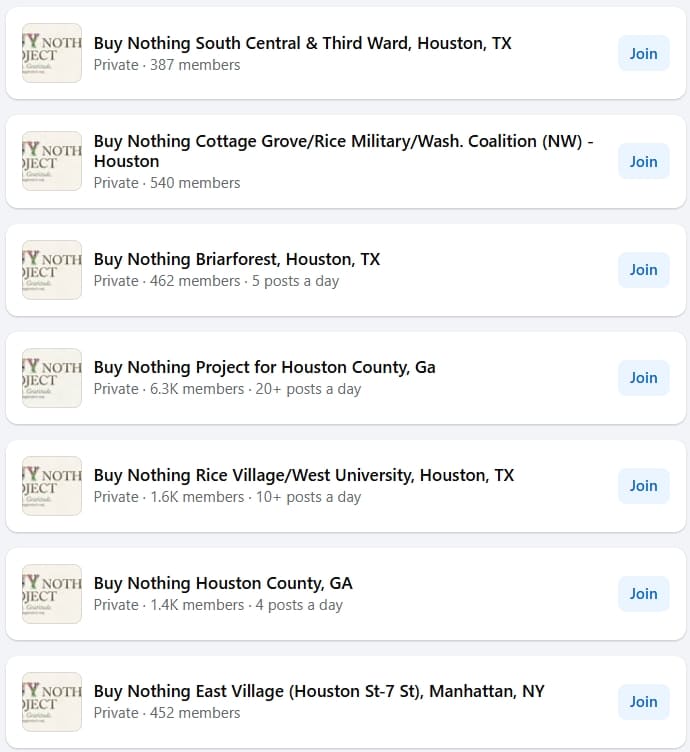
If there is a Buy Nothing group in your area, check it before buying something your family needs.
These groups allow people to give away things they no longer need, and you can find everything from children’s clothes and toys to books, kitchen items, and other household products.
This can be particularly useful for families with young children because kids can outgrow things so quickly. What no longer works for one family may be exactly what another family needs.
You can also offer things your own family no longer uses instead of letting them sit in a closet.
Look for a local group through Facebook or the Buy Nothing app. The availability of active groups depends on where you live, but it can be worth checking before buying something new.
Check Your Local Library for Free Family Activities
I think libraries are one of those resources that families can easily overlook when they’re looking for things to do.
Many libraries offer free story times, children’s activities, reading programs, crafts, workshops, and community events. Some also provide passes or partnerships that give members free or discounted access to museums and other attractions.
Check your library’s website or event calendar before paying for an activity somewhere else.
You can also subscribe to your library’s newsletter if they offer one. This is something I would recommend because you don’t have to keep remembering to check the library website. You’ll simply get notifications about upcoming activities, programs, workshops, and special events.

This can be especially useful during school holidays when children somehow develop a need to be entertained for 14 hours a day.
Look for Free and Low-Cost Family Activities
Family activities don’t always need a big budget.
Look for free museum days, community events, parks, playgrounds, local festivals, outdoor movie nights, and activities offered by community centers or local organizations.
At home, you can also have movie nights, play board games, cook together, bake, have a picnic, go for a walk, or spend an afternoon at a local park.
Growing up, I remember that some of the best times my family had didn’t require a lot of money. We’d watch TV together, spend a few quarters at the arcade or local carnival, or sometimes just go to McDonald’s—back when they still had playgrounds inside (do you remember those?). It didn’t matter what we did as much as that we were together and having fun.
You can also check local parenting groups, community pages, and event calendars for free or inexpensive activities.
I’ve also written about ways to save money on entertainment if you want more ideas.
You don’t have to make every weekend completely free. Having some low-cost options means you can spend less without making family time feel boring.
Spend Less on Birthdays and Holidays
I grew up without very grand birthday celebrations. My family didn’t usually throw big birthday parties for me. Instead, we might eat outside and do something fun afterward, like going to the arcade.
Looking back, I don’t remember wishing that my birthdays had been more elaborate. What I remember is spending time with my family and doing something I enjoyed.
That’s why I don’t think saving money means you have to stop celebrating birthdays or holidays.
If you’ve budgeted for a birthday and you can afford the celebration, I say go celebrate it. If your child has been looking forward to a particular party, there is nothing wrong with spending money on it when it fits your family’s budget.
I once came across a discussion where someone was being criticized for spending a significant amount on their child’s birthday party. The parent explained that they had already budgeted for it. Someone else made a point that stuck with me: sometimes celebrating a child’s birthday is also about celebrating the fact that the parents made it through another year of raising that child.
I think there is something to that.
A birthday doesn’t have to be expensive to be special, but it also doesn’t have to be cheap just for the sake of saving money. Maybe your family wants a big party. Maybe you prefer a family dinner and an arcade visit. Maybe your child wants to spend the day at a favorite activity.
Decide what matters to your family and budget for it.
When you’re celebrating outside the home, also check for birthday freebies and special offers. Restaurants, entertainment venues, attractions, and other businesses may offer birthday meals, desserts, activities, or discounts depending on where you live.
For holidays, set a spending limit before you start buying gifts, decorations, food, and activities. You can also set aside money throughout the year for birthdays and holidays so those expenses don’t all land on your budget at once.
Review Subscriptions and Household Bills
Recurring expenses are worth checking because they can continue taking money from your budget even when you aren’t paying much attention to them.
Look at streaming services, memberships, phone plans, internet plans, insurance, apps, and other subscriptions. You may find services your family barely uses or plans that no longer make sense for your household.
You don’t have to cancel everything.
If your family watches one streaming service regularly, keeping it may make more sense than canceling it just because you’re trying to save money. The goal is to spend less on things you don’t really use, not to remove every enjoyable expense from the budget.
I also recommend reviewing your subscriptions every few months. A service you wanted six months ago may not be something your family uses anymore.
You can read my guide on how to save money on streaming subscriptions for more ideas.
The same applies to other household bills. Check whether cheaper plans are available and whether you’re paying for features your household doesn’t really need.
Save Money on Eating Out
My family actually loves eating out.
For us, going out for a meal on a Saturday or Sunday can be a way to spend time together, so I wouldn’t tell a family to completely stop dining out just because they’re trying to save money.
Instead, you can make room for eating out in the budget.
Maybe your family eats out once a week instead of several times throughout the week. Maybe you choose one weekend meal to have at a restaurant and cook the rest at home.
You can also lower the cost of each meal by checking the menu beforehand, skipping unnecessary add-ons, choosing reasonably priced meals, or sharing larger portions when appropriate.
For me, the point isn’t to remove every expense that isn’t strictly necessary. If something brings your family together and you’ve budgeted for it, there’s room for it.
If you want more practical ideas, I have a guide on how to save money on dining out.
Reduce Transportation Costs
Transportation can be a major household expense, especially for families that drive frequently.
Look for ways to combine errands, so you aren’t making several separate trips. If practical and safe, walking, cycling, public transportation, or carpooling can also reduce some transportation costs.
Regular vehicle maintenance is another expense worth planning for. Taking care of the car can help you avoid larger repair bills later.
You can also consider parking costs, insurance, fuel spending, and driving habits when deciding where to cut back.
Not every family will have the same options. Someone living in a city with reliable public transportation may be able to drive less, while another family may depend on a car for almost everything. Look at what makes sense for your household rather than trying to copy someone else’s routine.
Give Kids Age-Appropriate Money Responsibilities
I learned some of my earliest money habits from my mom.
When I was a kid, she would give me a piggy bank so I could save my money. During Christmas and holidays, my aunties would sometimes give me money, and I’d put it in my piggy bank instead of spending it all right away.
If I wanted to buy something, my mom would give me money for smaller purchases. But if I wanted something more premium, I had to work for it.
That taught me that if I wanted something beyond the basics, I could save for it or work toward it myself.
You can give children similar opportunities in ways that fit their age. They can compare prices at the grocery store, decide between similar products, understand needs versus wants, or save toward something they really want.
An allowance can also give older children a chance to practice managing money. You could divide their money between spending and saving, or use a simple system such as the three-jar method.
My guide to the three-jar method for budgeting with kids explains how you can use this approach at home.
I also think parents need to remember that children pay attention to what adults do. You can tell a child to save money, but they are also watching how you spend yours.
If they see you comparing prices, saving for larger purchases, thinking about whether something fits the budget, and making room for things you genuinely enjoy, those habits become much easier for them to understand.
You don’t have to lecture children about personal finance every week. Sometimes they learn more by watching how their parents handle ordinary money decisions.
Set Family Savings Goals
A savings goal can give the whole family something specific to work toward.
It could be an emergency fund, family vacation, school expenses, a vehicle repair fund, holiday spending, or a birthday celebration.
Instead of looking at the entire amount at once, break it into smaller amounts.
For example, if your family wants to save $1,200 for a vacation in one year, that’s $100 per month.
You can also create a simple visual tracker for children, such as a chart they can color in as the family gets closer to the goal.
I like the idea of letting children see progress because saving can otherwise feel very abstract to them. If they can see that the family is getting closer to something everyone wants, they have a reason to understand why you’re choosing not to spend that money somewhere else.
When you reach a milestone, celebrate it in a way that doesn’t undo the savings. A family movie night, picnic, favorite homemade meal, or another inexpensive activity can be enough.
Weave Saving Into Everyday Family Life
Saving money while raising a family doesn’t mean cutting out all the fun or saying no to everything your family enjoys. It’s about making intentional choices, focusing on what matters most, and discovering simple ways to save on family expenses every day. Even small habits—like checking what you already have at home or planning ahead for meals and activities—can make a big difference over time.
By being thoughtful about your spending, you can build good habits, ease financial stress, and still make space for the traditions, treats, and moments your family loves most. In the end, it’s not about perfection, but about finding a balance that works for your family.