

If you save $100 a week for a year, you’ll have $5,200 saved after 52 weeks.
The calculation is simple:
$100 × 52 weeks = $5,200
The harder part is finding that extra $100 in your budget every week.
You don’t necessarily need to cut one huge expense to reach the goal. For many people, the $100 can come from several smaller changes to spending they already do, such as eating out less often, cutting back on impulse purchases, or finding cheaper alternatives for things they buy regularly.
Here’s what saving $100 a week actually looks like and how you can find an amount that works with your budget.
How Much Is $100 a Week for a Year?
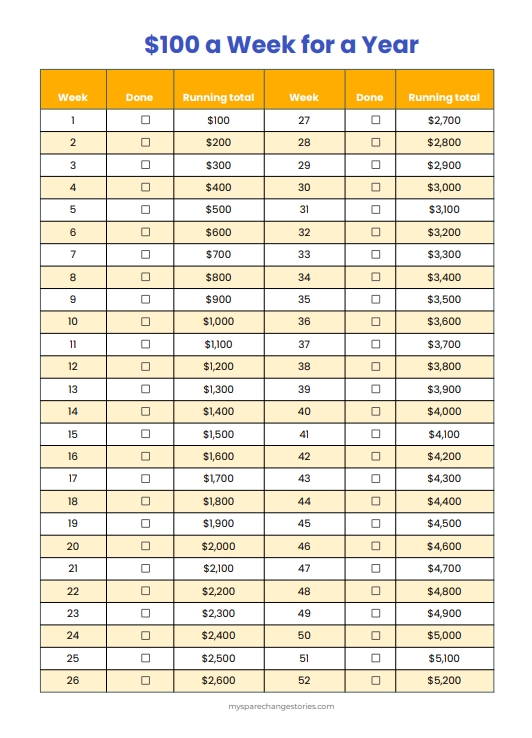
So if you’re wondering, “If I save 100 a week for a year, how much will I have?”, the answer is $5,200.
It also works out to an average of about $433 per month, although your actual monthly savings can vary because most months don’t contain exactly four weeks.
What If I Save $100 Every 2 Weeks for a Year?
If saving $100 every week doesn’t fit your budget, you could save $100 every two weeks instead.
There are approximately 26 two-week periods in a year:
$100 × 26 = $2,600
So if you save $100 every 2 weeks for a year, you could have about $2,600 by the end of the year.
That’s half the weekly goal, but it can still give you a substantial amount to put toward an emergency fund, debt, a planned purchase, or another savings goal.
If you prefer a challenge that starts with a smaller amount and gradually increases each week, you can also try the 52-week savings challenge. Unlike the $100-a-week challenge, the amount you save changes each week as you work through the year.
Where Can the $100 Come From?
Instead of looking for a single way to “make” an extra $100 every week, look at the money you’re already spending.
Go through your usual weekly or monthly expenses and ask:
Which expenses can I reduce without making my budget difficult to live with?
Here are some categories you can review:
The amounts in this table are examples, not recommended spending cuts. Your own expenses may look completely different.
The goal is to look at your actual spending and identify the categories where you have some room to adjust.
Use Your Actual Spending to Find Your Number
This is where your budget becomes more useful than a generic list of money-saving tips.
Look at your actual transactions from the last few weeks or months.
Ask yourself:
- What do I buy every week?
- Which expenses are optional?
- Which purchases happen because they’re convenient?
- Where do I regularly spend more than I planned?
- Which expenses could I reduce without affecting necessities?
- How much could I realistically reduce from each category?
You might discover that your $100 is already sitting inside your current spending.
You just need to decide which parts you’re willing to redirect toward savings.
What If You Miss a Week?
Missing one week doesn’t mean the entire savings challenge is ruined.
If you planned to save $100 but couldn’t, you have a few options.
You could simply continue with the next $100 deposit. Or, if your budget allows, you could make up part of the missed amount later.
For example, if you miss one week, you could save:
- $100 the following week and leave the missed week alone
- $125 for four weeks
- $150 for two weeks
- An extra amount whenever you have additional money available
You don’t have to turn one missed deposit into a reason to abandon the entire challenge.
If making up the missed amount would put pressure on your regular bills or necessities, continuing with your normal target may make more sense.
Keep Your $100 Savings Separate
Once you’ve identified where your $100 is coming from, make it easier to keep the money by moving it out of your spending account.
You could use a separate savings account or another account specifically for your goal.
If your bank allows automatic transfers, you can schedule the transfer around payday.
For example:
Payday → $100 automatically moves to savings → remaining money stays available for your regular budget
This removes one decision from your weekly routine.
It can also help prevent the money you’ve set aside from being mixed with the money you’re planning to spend.
What Could You Do With $5,200?
Saving $5,200 gives you several options, depending on your financial priorities.
You could use it for:
- Building or adding to an emergency fund
- Paying for a planned large expense
- Creating a sinking fund
- Paying down debt
- Saving for a vacation
- Covering home or car expenses
- Putting money toward a future purchase
- Adding to long-term savings
You don’t have to decide exactly what you’ll do with the money before starting the challenge.
You can simply give the money a purpose as you get closer to your goal.
If you’re interested in other ways to save money, you can also explore these money-saving challenges for different savings amounts and timelines.
Is Saving $100 a Week Realistic?
Saving $100 a week is realistic for some budgets and too aggressive for others.
The easiest way to figure out where you stand is to look at your actual spending.
If you already have $100 of flexible spending that you could reasonably reduce, the challenge may fit without requiring a major change.
If your budget is already tight, forcing yourself to save $100 could mean falling behind on bills or relying on credit to cover regular expenses. In that situation, a smaller savings target may make more sense.
You can still use the same idea with $25, $50, or $75 a week and increase your target later.
What matters is that the amount you choose fits into the budget you actually have.
What $100 a Week Can Add Up To
Saving $100 a week for a year can give you $5,200, but the more useful part is figuring out where that $100 can realistically come from. Look at your actual spending, reduce a few flexible expenses, and move the money into savings each week. If $100 feels too high for your budget, start with $25, $50, or $75 and build from there. The goal is to save an amount you can actually keep up with for the full 52 weeks.