If you’re on the hunt for a low income savings challenge, you’re probably looking for something that won’t eat your grocery money or leave you staring at your bank app in horror. The eleven plans below are all about small, doable deposits and a finish line you can actually see, whether that’s $100 in 30 days, $1 a day, or a 52-week challenge that never asks for more than $26 at once.
Low Income Savings Challenges at a Glance
The $100-in-30-days plan gets the spotlight here because it’s the fastest way to the finish line, and the rest are sorted by how much you’ll need to put in at once.
The $100 in 30 Days Challenge (A Low Income Monthly Savings Challenge)
Breaking $100 into 30 days means about $3.34 a day, which is sneaky enough to blend in with your regular spending. Or, if you’re more of a weekly person, that’s $25 a week. This plan resets every month, so if you keep it going all year, you’ll have $1,200 by the end.
The $1 a Day Challenge (A Low Income Mini Savings Challenge)
Saving a dollar a day for 30 days gets you to $30, which is a mini challenge with a finish line you can actually spot from the starting line. If you’d rather sprint, try a seven-day round for $7. Go the distance for a year and you’ll hit $365, which is satisfyingly neat.
You might also like: Saving a Dollar a Day for a Year
The Half 52-Week Challenge
The classic 52-week challenge starts at $1 and ends at $52, which sounds great until you hit those big numbers at the end. Halving each deposit gives you a version that starts at $0.50, tops out at $26, and lands at $689 for the year. You still get the slow-and-steady climb, but your paycheck won’t have to do gymnastics. A printable grid with 52 squares lets you color in your progress week by week, and the milestone table below gives you a quick peek at how far you’ve come.
The Penny Challenge
Day 1 is a penny, day 2 is two pennies, and by the end of the year you’re up to $3.65 a day, which adds up to $667.95 (or 66,795 cents, if you like big numbers). You won’t even hit $1 a day until day 100, so the first three months are basically pocket change. I used to have a coin bank that was too cute to open, and because I didn’t want to ruin it, I just kept dropping coins in and left it alone, which is how I ended up with more savings than I expected, though I did have to open it eventually. You can run this challenge with coins, a phone transfer, or whatever works in your currency. Most people use a 365-box chart and color in a square each day, which is a lot more satisfying than it sounds.
The $5 Per Paycheck Challenge
Just save $5 every payday—no fancy schedule needed, just whatever your pay calendar says. Your yearly total depends on how often you get paid: $260 if it’s weekly, $130 for every two weeks, $120 for twice a month, and $60 if you’re paid monthly. On a $500 paycheck, $5 is just 1%, so this is the percentage-based challenge banks love to talk about, only shrunk down to something you’ll actually remember. I’ve got a printable checklist with a box for every payday, so you can keep track without any mental gymnastics.
Ready for Your Next Money Saving Challenge?
Pick a challenge that fits your budget, print the free tracker, and color in a box every time you save. Watching the squares fill up is half the fun.
Get My Free Printables →The $5 Bill Challenge
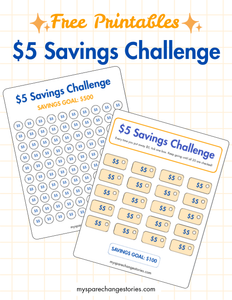
Every time a $5 bill shows up in your wallet, it goes straight into an envelope. The only rule: no sweet-talking the cashier into giving you fives, and no swapping other bills just to get them. This is the same idea as my $5 savings challenge, and since the total depends on how often fives appear, it’s a bit of a mystery until you count it up. If your currency doesn’t have a $5 note, just pick the closest one. Keep a tally on the envelope or use a printable with a box for each $5—super handy when there’s no set schedule.
The Round-Up Challenge
Each purchase gets rounded up to the next dollar, and the difference goes into savings, so a $3.40 purchase adds $0.60. Rounding up transaction amounts is how I got started when I first began budgeting, which gives this plan a soft spot in my heart, and it works with a jar for the coins you get back in change or with a bank feature that automates it on debit card purchases, though the stash grows slowly because each round-up is under a dollar. A weekly tally sheet gives that slow growth something to show for itself.
The Weekly Dice Roll
Roll a single die once a week and save that many dollars, so a 1 puts $1 in the jar and a 6 puts $6, which adds up to somewhere between $52 and $312 over 52 weeks depending on how the dice fall. Rolling daily instead would run $365 to $2,190 a year, so the weekly roll is the version sized for a small paycheck, and a 52-box tracker where you write in each roll keeps a record of the luck.
The Swap-and-Save Challenge
Write down a handful of routine purchases, pick a cheaper alternative for each one, and move the difference into savings each time you make the swap, so replacing a $4 item with a $3 one sends $1 to the jar. The total depends on how often the swaps happen, which suits irregular income, and a list of swaps taped inside a cupboard door doubles as the tracker.
The 12-Week Holiday Fund Challenge
Saving $25 a week for 12 weeks totals $300, a round number that suits a holiday fund and splits into $50 every two weeks for anyone paid on that schedule. Counting back 12 weeks from the holiday date sets the starting line, and a 12-box tracker with one box per week keeps the count.
The No-Spend Week
A no-spend week skips nonessential spending (takeout, impulse buys, extras) for seven days and moves the amount you would have spent into savings. A week is a short enough stretch to try without much planning, and my no-spend challenge rules cover how to stretch it to a month once a week goes smoothly. A seven-day checklist with a box for each no-spend day makes the week easy to track.
Where the Money Goes
High-yield savings accounts usually pay more interest than standard ones, and the protection on your balance depends on your country’s deposit insurance scheme, so a quick look at your bank’s terms covers that.
Matching a Challenge to Your Pay Schedule
Money saving challenges for low income budgets tend to run into pay timing before anything else, so weekly pay lines up with the $25-a-week version of the $100 plan, the half 52-week challenge, the weekly dice roll, or the 12-week holiday fund, and monthly pay lines up with $5 per paycheck or a single monthly round of the $100 plan. Irregular pay from gig work, seasonal work, or changing hours pairs better with the round-up, the $5 bill rule, swap-and-save, or a no-spend week, since none of them depend on a deposit date. Daily challenges build a habit quickly while weekly ones are simpler to track.
One Small Jar at a Time
The eleven plans above run from $30 in a month to $689 in a year, with any single deposit staying at or under $26, and a jar by the door has a way of being right where you left it when the next paycheck arrives.